


Toll Manufacturing Minute with CPS: 25 Years, Five Departments, and What Institutional Memory Means for Customers

TL; DR: EPISODE OVERVIEW
CPS Master Data Manager Eddie Murray has spent 25 years at Custom Processing Services, working in production, quality control, inventory and logistics, technical sales, and data management. That cross-department experience lets him solve customer problems that touch several functions at once, such as balancing packaging, GMP requirements, and DOT trucking limits on a single shipment. For CPS customers, a long-tenured team means fewer surprises during scale-up, faster turnaround, and a quicker path from new product to commercial production.
Most toll processing problems don’t stay inside one department. A packaging choice changes pallet weight, pallet weight changes what fits on a truck, and the container that fits the truck still has to meet GMP requirements and survive transport without the powder compacting. When the people working the problem have only seen one piece of it, the customer pays for the gaps in lost time, rework, or freight costs.
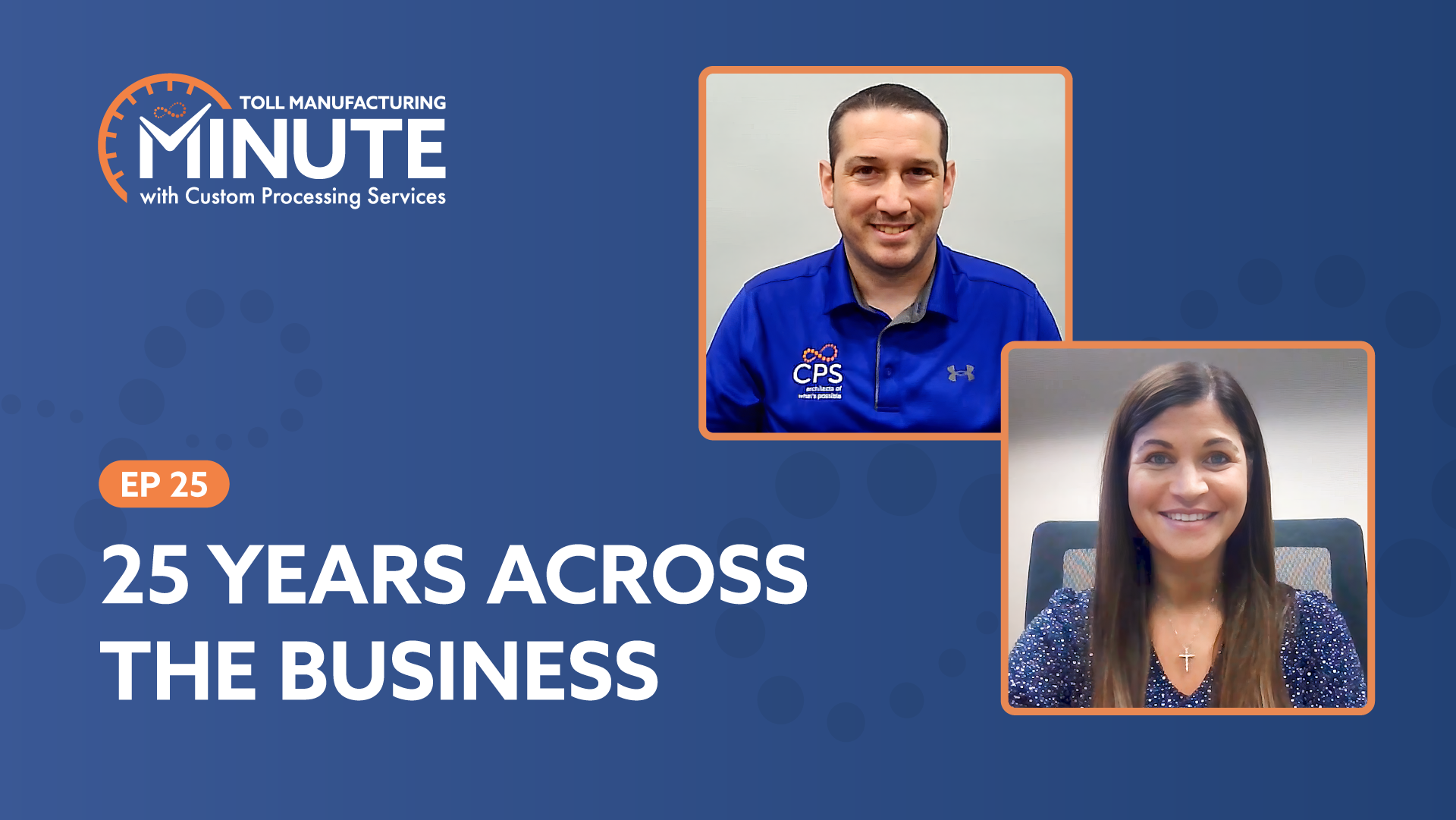
Eddie Murray has seen every piece. He joined CPS 25 years ago as a part-time chemical mill operator and has worked in nearly every part of the business since. To mark the podcast’s 25th episode, Marketing Team Coordinator Jen Lepore sat down with Eddie to talk about his career, what CPS did to make it possible, and what customers gain from a team with that kind of history.
From Summer Job to Master Data Manager
Eddie’s first CPS job came through a neighbor of co-founder Gregg Shemanski, who mentioned the company needed part-time summer help. Eddie worked nights and weekends while earning a dual degree in business administration and computer science. Each move after that followed the company’s growth:
- Production: Chemical mill operator, then third-shift lead operator for about a year and a half
- Quality Control: QA technician, then lead QA technician, running and maintaining lab equipment and handling reports for about seven years
- Inventory and Logistics: Product flow coordinator managing intra-company material movement for about nine years, his first move from the floor to the front office
- Technical Sales: Technical sales coordinator handling the order management and scheduling behind customer trials for about three years
- Master Data Management: His current role, overseeing how CPS handles and uses the data in its ERP system as AI becomes a larger part of the business
Looking back, Eddie says the inventory role mattered more than he expected. It showed him how the business ran beyond the plant floor and gave him his first real experience managing people.
Making Changes That Work for Every Department
Eddie describes his daily goal plainly: make the job easier for everyone at CPS. Because he has worked in so many departments, he knows the small nuances and unwritten steps that keep each one running. That lets him test a change against everyone it touches before he makes it.
“I’m trying to make changes that are beneficial for everybody, but I don’t want to make somebody’s job easier at the expense of making somebody else’s job that much harder. Knowing everybody’s jobs and what goes into them really helps me do that successfully.”
He also credits a former quality control lab manager with a standard he still follows. The lab’s saying was, “I don’t care if nothing ships today, but what does ship is going to be good.” Material, packaging, and paperwork all had to be right before anything left the building.
One Shipment, Three Departments: A Customer Example
A customer wanted to fit as much finished product as possible on each outbound truck to lower shipping costs. It sounded like a logistics question. Solving it took three departments working from the same set of constraints:
- Production: Finding a packaging configuration that worked with CPS equipment and the customer’s product, fit the most material per pallet, and matched what the end user could receive
- Quality: Choosing packaging that met GMP requirements and kept the material from compacting and becoming unusable in transit
- Logistics: Working within pallet dimensions, pallet weight, and DOT limits on trailer height, weight, and floor space
Eddie had worked all three roles, so he could weigh those constraints together instead of passing the problem from desk to desk. CPS met the customer’s goal. That kind of decision-making, Eddie says, is how CPS lives up to its quality policy of meeting or exceeding customer expectations and requirements across quality, supply chain, and pricing.
Why Institutional Memory Shortens the Path to Commercialization
New products carry unknowns. Until a material runs, nobody knows for certain how it will process, how it will fit in a package, or how it will react to certain conditions. Eddie says people who have worked the floor, and not only managed it on paper, can draw on past runs to make better early calls on packaging, weights, configurations, and even equipment selection.
Long tenure adds to that advantage. Team members who have been at CPS for years can spot likely bottlenecks and sticking points before a project reaches them, then plan around them from the start. For customers, Eddie says, that means quicker turnaround and a faster, less painful route to commercializing new products.
What Changed in 25 Years, and What Didn’t
When Eddie started, CPS had one facility, three production stations, and five full-time employees, owners included. Today the company operates four production facilities, two off-site warehouses, and more than 40 production stations, with a team of more than 150 people and its own in-house trucking division. Another new division is launching soon.
What stayed constant, in Eddie’s view, is how CPS treats customers. The company’s aim from day one has been to act as a partner in toll processing, offering the personal attention of a small business backed by the resources of a large one.
How CPS Keeps Career Paths Open
Eddie’s path was possible because CPS doesn’t lock people into the role they were hired for. If someone performs well and has the attributes a new role requires, the company gives them a chance, degree or certification in that area or not. He has watched operators move into the lab and into maintenance because they preferred working on equipment to working with it.
Mobility takes effort on both sides. Eddie’s advice for employees and managers:
- Master your current role first: Learn everything you can from leaders and peers, because that knowledge creates the next opportunity
- Ask: If you feel stuck or see a role that fits your strengths, ask what it takes to be considered
- Be patient: Vertical moves take time, and each role you master opens more options
- Managers, look for fit: An analytical employee who isn’t suited to physical equipment work may belong in quality testing or client services
He also pushes back on the idea that manufacturing careers dead-end at shift leader or floor manager. Maintenance, quality, transportation, and logistics all need people, and those roles are where many of the opportunities sit.
For CPS customers, a team built this way translates into direct benefits:
- Fewer surprises in scale-up, because experienced staff anticipate bottlenecks before they occur
- Faster turnaround and commercialization for new products
- Decisions that account for quality, packaging, supply chain, and logistics together
- Continuity from long-tenured staff who know how CPS processes and departments fit together
Reach out to learn how the CPS team can support your next toll processing project.

KEY TAKEAWAYS:
- Who: Eddie Murray, Master Data Manager, Custom Processing Services (CPS)
- Background: 25 years at CPS across production, quality control, inventory and logistics, technical sales, and master data management; dual degree in business administration and computer science
- Focus area: Managing CPS data and ERP systems so every department can do its job more easily
- Core themes: Cross-department knowledge, institutional memory, quality before shipping, internal career mobility, and solution-focused problem-solving