

.png?width=100&height=110&name=CPS-Logo-rgb-no-callout%20(1).png "CPS-Logo")
Cross-Contamination Control Is a Changeover Discipline

TL;DR
Cross-contamination is the unintended transfer of material from one batch or product into another. In specialty chemicals and coatings, even trace carryover can change purity, reactivity, color, and particle size. Deviations lead to failed testing, downtime, and supply-chain disruption. The highest-risk moment is the changeover. Prevention depends on standardized cleaning, smart sequencing, and verification matched to product sensitivity.
Cross-contamination begins in transition, not production. In high-sensitivity processing, how you manage changeovers determines whether performance and results are protected or compromised.
What Is Cross-Contamination in Specialty Chemical Processing?
Cross-contamination in specialty chemical processing occurs when unintended material from a previous batch or environment carries into a new product, affecting purity, performance, or specifications.
It can result from:
- Residual material left in equipment
- Airborne dust migration
- Shared tooling or transfer systems
- Incomplete changeovers
- Cross-contact between different product grades
“In high-sensitivity applications, even trace contamination has consequences,” explains CPS Chief Operating Officer Ken Zrebiec. “Downstream production may not have the right processing steps in place to remove the impurity, resulting in performance vulnerabilities, rework, and expense.”
Why Cross-Contamination Is a High-Stakes Risk
In addition to being a cleanliness issue, cross-contamination is a performance and business risk.
In food & beverage, pharma, and other regulated industries, product specifications are often tight. Small deviations in specialty chemicals can alter:
- Purity
- Reactivity
- Color intensity
- Particle size distribution
- Functional performance
A contaminant introduced early in processing may not be detected until formulation, analytical testing, or customer receipt. By that point, the impact expands beyond scrap.
The cost of failure increases the further contamination travels downstream. Hidden costs include:
- Investigation time
- Lost production hours
- Supply chain disruption
- Customer dissatisfaction
- Internal resource diversion
Companies that treat contamination control as a strategic discipline rather than a routine cleaning task reduce variability, protect performance, and minimize downstream risk.
Where Companies Underestimate Contamination Risk
Cross-contamination risk is often underestimated when equipment appears visually clean. However, visual inspection alone does not eliminate risk.
Common blind spots include:
- Hard-to-clean areas
- Dead zones or hold-up volumes
- Complex transfer paths
- Dust collection interfaces
- Incomplete disassembly during cleaning
Zrebiec expands on this point:
“One of the key gaps to fill in contamination risk management is having a full understanding of the equipment. Without knowing the design and behaviors of materials that run through it, proper cleaning is highly unlikely. It opens the door to cross-contamination.”
Another frequently overlooked issue is cross-contact between different grades of the same product. “Even when the base material is identical, variations in spec can be a contaminant,” Ken says. “Running different grades of the same product without accounting for the nuances of particle size and behavior can alter performance if carryover occurs.”
What Makes a Product “High-Sensitivity”?
A high-sensitivity product is one where small material variations create measurable performance impact.
Sensitivity factors often include:
- Tight purity targets
- Reactive formulations
- Strong tint strength or pigmentation
- Fine particle size requirements
- Trace-level performance thresholds
The higher the product sensitivity, the lower the tolerance for residual carryover.
Why Changeovers Are the Highest-Risk Moment
Changeovers represent the most vulnerable point in contamination control. Risk increases because:
- Equipment is opened and reassembled
- Cleaning decisions are made under time pressure
- Procedures may vary between operators
- Production sequencing shifts
If changeovers are rushed or inconsistent, residual material can remain or migrate.
Effective changeover control depends on:
- Standardized procedures
- Documented cleaning protocols
- Clear cleaning criteria
- Operator training
- Verification methods
Changeovers are both operational transitions and performance protection systems.
How Cross-Contamination Affects Downstream Performance
Trace contamination becomes problematic when downstream processes are not designed to remove it.
For example, if purification relies on water filtration and the contaminant is not water-soluble, it may pass through the process unchanged.
Downstream impacts may include:
- Unexpected impurities in analytical results
- Off-color material
- Altered reactivity
- Reduced yield
- Formulation instability
Even if contamination is caught early in testing, it still results in downtime and investigation.
Preventing Cross-Contamination in Practice
Reducing contamination risk requires a systematic approach that includes:
- Equipment design awareness
- Full understanding of material behavior
- Production sequencing strategies (e.g., compatible-to-compatible, dark-to-light runs)
- Standardized changeover procedures
- Defined “clean enough” criteria
- Verification methods such as visual inspection, swabbing, or analytical confirmation
- Consistency across shifts and operators
Effective changeover control cannot rely on cleaning alone. It requires a structured system that balances rigor with efficiency.
Changeover Planning and Verification Principles: A Practical Framework
Without a defined verification framework, teams may either under-clean high-risk transitions or over-clean low-risk ones, increasing operational drag and downtime. Verification provides evidence that cleaning was effective. It should scale with risk and incorporate well-documented guiding principles:
Changeover Risk: Matching Rigor to the Next Product
Not all changeovers carry equal contamination risk. A structured approach to processing specialty chemicals and coatings begins by categorizing transitions based on product sensitivity and compatibility.
Low-Risk Transitions
- Same product family
- Similar color or tint strength
- Compatible chemistry
- Low downstream sensitivity
Equipment cleaning best practices may include:
- Dry clean or purge
- Targeted wipe-down
- Visual inspection
Moderate-Risk Transitions
- Same base chemistry but different grade
- Moderate color contrast
- Additive variation
- Moderate sensitivity specifications
Equipment cleaning best practices may include:
- Partial disassembly
- Wet wash or solvent rinse
- Documented inspection checklist
- Targeted wipe/swab verification
High-Risk Transitions
- Incompatible chemistries
- Dark-to-light color shifts
- High-potency or high-sensitivity materials
- Tight impurity thresholds
- Downstream processes unable to remove impurity
Equipment cleaning best practices may include:
- Full teardown
- Wet wash or solvent flush
- Swab verification
- Analytical confirmation
When managing risk, the goal is not to treat every changeover the same. The goal is to apply rigor where it protects performance.
Defining “Clean Enough”: Risk-Based Standard, Not Guesswork
For specialty chemicals and coatings, meeting the FDA’s “clean enough” standard for equipment changeovers means:
Visual Cleanliness
Equipment is visibly free of:
- Dirt or debris
- Residual powder or liquid
- Previous product color
- Material trapped in seams, corners, or gaskets
However, “looks clean” is not enough for a defensible clean-enough threshold.
Scientific/Operational Verification
Equipment meets pre-defined, documented limits based on:
- Targeted wipe or swab testing
- Rinse sampling in wet-clean systems
- ATP or similar surface cleanliness tests
- Analytical confirmation for high-risk transitions
Performance-Based Tolerance
“Clean enough” is tied to the next batch’s tolerance for carryover, such as tight impurity limits or high tint sensitivity in specialty chemicals and coatings. To dial in the cleaning threshold, answering performance-based questions about trace residue is necessary.
Will trace residue:
- Shift tint strength?
- Introduce impurity peaks in analytical testing?
- Affect reactivity or downstream yield?
- Be removed by the downstream process, or will it survive?
Clean-to-Inspect
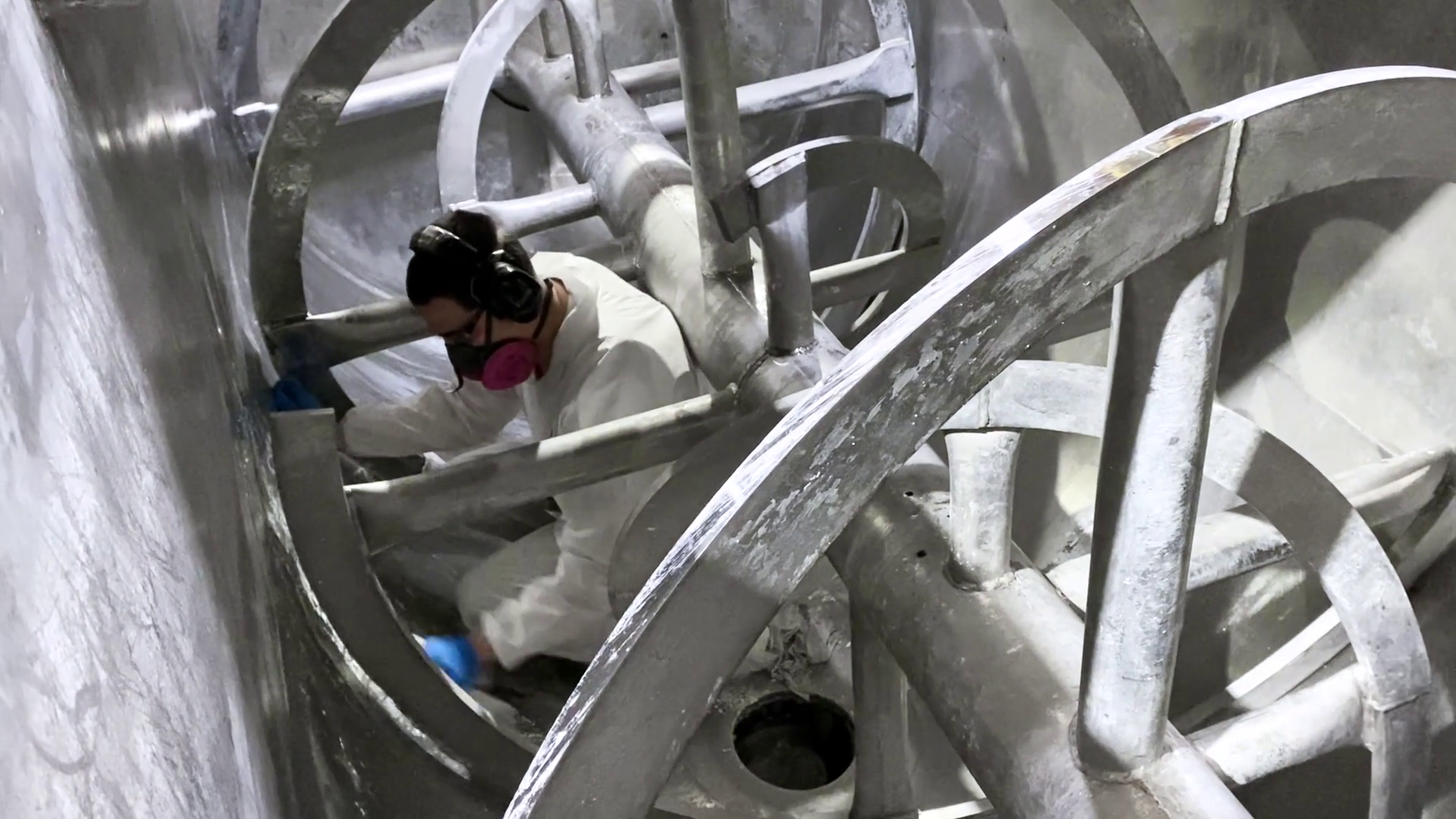
Cleaning for transitions also serves as an opportunity to inspect and confirm equipment integrity before restart.
During changeover, teams should:
- Physically access high-risk zones
- Inspect seals, gaskets, and transfer paths
- Check for wear, damage, or build-up
All told, the difference between “fast” and “efficient” changeovers is this: fast reduces cleaning time; efficient reduces cross-contamination risk and total disruption. Having a toller that knows the difference helps OEMs in coatings & inks, food & beverage, pharma, and other regulated industries protect product performance and alleviate the risk and cost of cross-contamination.
The Toll Processor Evaluation Checklist is an excellent tool for digging into how your current or prospective toll processing partner approaches and manages vital project and process areas.

Frequently Asked Questions
What Is cross-contamination in MANUFACTURing?
Cross-contamination in manufacturing is the unintended transfer of residue, dust, or material from one batch or product into another during processing. It most commonly occurs through incomplete cleaning, shared equipment, or airborne particles.
What causes cross-contamination in specialty chemical processing?
Cross-contamination is typically caused by residual material left in equipment or transfer paths. Common causes include:
- Hard-to-clean dead zones
- Shared tools or containers
- Airborne dust migration
- Incomplete cleaning during changeovers
- Rushed or inconsistent procedures
Why is cross-contamination a major risk for specialty chemicals?
Specialty chemicals often have tight performance specifications. Even trace contaminants can affect purity, reactivity, color consistency, particle size, and functionality, leading to measurable performance changes.
When is cross-contamination most likely to occur?
Cross-contamination is most likely to occur during changeovers between products or grades, especially when cleaning procedures are inconsistent or rushed.
Can different grades of the same material cause cross-contamination?
Yes. Different material grades may vary in particle size, additive content, or purity. Even small carryovers from one grade to another can alter performance in high-sensitivity applications.
What equipment features increase contamination risk?
Equipment features that increase risk include:
- Dead legs and internal corners
- High hold-up volume areas
- Complex transfer paths
- Dust collection interfaces
- Limited accessibility for cleaning
How do manufacturers prevent cross-contamination during changeovers?
Prevention requires strict attention to standardized equipment cleaning procedures, including:
- Full disassembly where required
- Intentional production sequencing
- Defined cleaning acceptance criteria
- Verification methods
- Operator training and repeatability