

.png?width=100&height=110&name=CPS-Logo-rgb-no-callout%20(1).png "CPS-Logo")
Toll Manufacturing Minute with CPS: The State of Contract Manufacturing: Industry Trends, Reshoring & the Value of SOCMA

TL; DR: EPISOde OVERVIEW
The contract manufacturing industry is resilient. The specialty chemical companies currently thriving in it are the ones paying attention to regional supply chain realignment, workforce transitions, and the rising importance of trust over price. In this episode, SOCMA leaders Jenny Gaines and Joe Dettinger share what the 2026 Outlook Report data is showing, why active industry involvement matters more than ever, and what it really means to have a trade association in your corner when the landscape keeps changing.
The contract manufacturing industry doesn't exist in a vacuum. Tariffs, supply chain disruptions, workforce transitions, and the push to bring production closer to home all impact how specialty chemical manufacturers operate, and how they partner with suppliers.
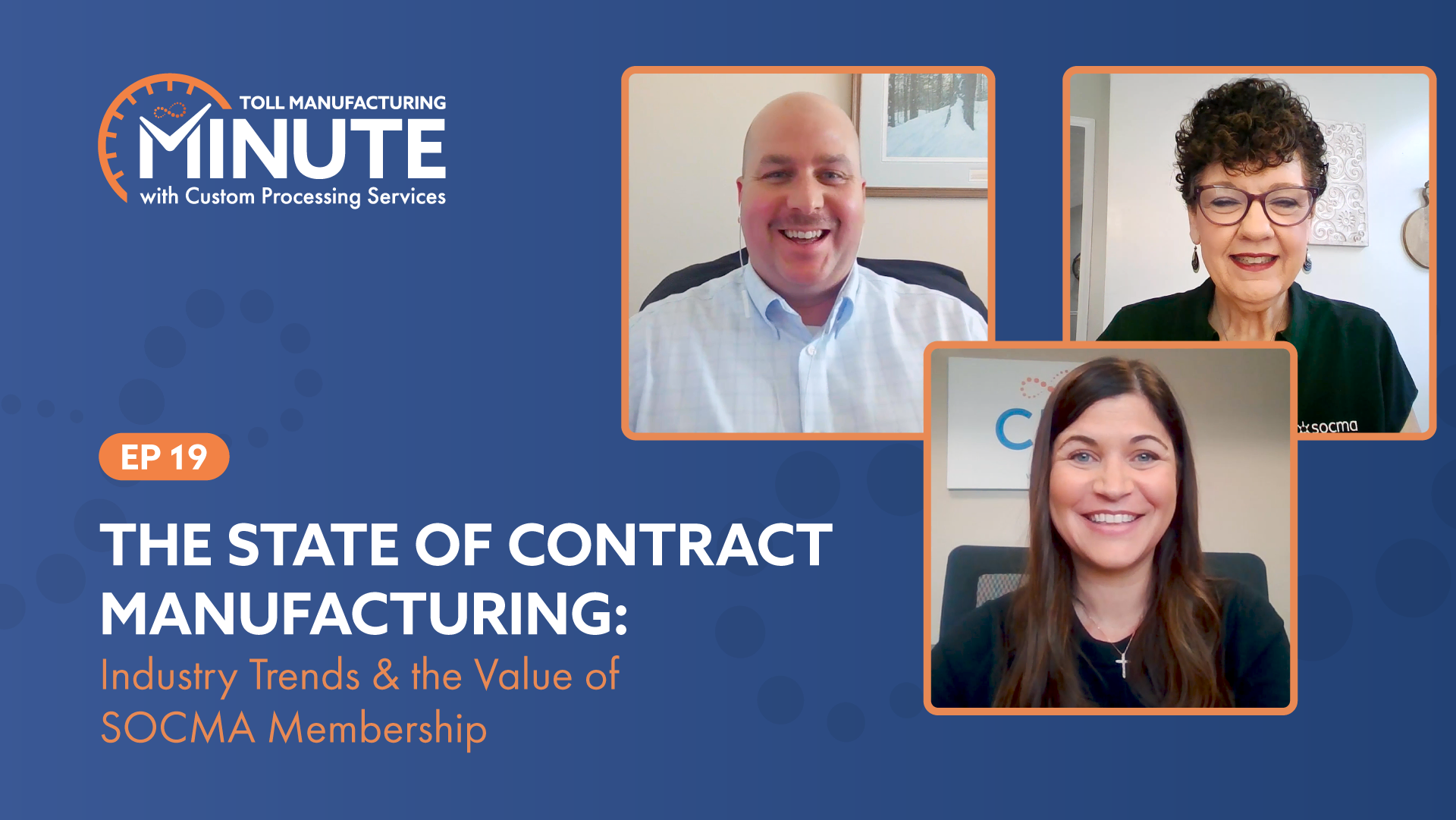
In a recent episode of the Toll Manufacturing Minute podcast, Jen Lepore sat down with two leaders from the Society of Chemical Manufacturers & Affiliates (SOCMA): Jenny Gaines, VP of Membership, and Joe Dettinger, VP of Manufacturing & Commercial Programs. Together, they unpacked what the industry looks like right now, what SOCMA's 2026 Contract Manufacturing Outlook Report is showing, and why active industry involvement matters more than ever in uncertain times.
WhAT IS SOCMA?
SOCMA is the only trade association in North America focused exclusively on specialty batch chemical manufacturers and their supply chain. With more than 350 members and 105 years of history, it operates across three core areas: commercial development, manufacturing and operations, and advocacy.
For members, that translates into a broad range of practical resources, including trade show access and B2B lead matchmaking, environmental health and safety programs like ChemStewards®, KimOps online training, gap analysis support, and ongoing specialty chemical industry advocacy.
Jenny Gaines noted that in addition to broad legislative priorities, roughly 40% of SOCMA's advocacy time is spent on issues unique to individual member companies. “We are the voice of specialty batch chemical manufacturers,” she explained. “We are there to offer holistic support in all key areas.”
Beyond formal programs, SOCMA offers something harder to quantify: a community. In an industry where companies can be competitors on one project and partners on the next, the ability to gather in a trusted space creates relationships that foster collaboration and mutual success.
The Industry in 2026: Resilient, BUt Complex
Chemistry is everywhere in daily life. The water we drink, the medications we take, the smartphones in our pockets, the coatings on our cars, solar panels, EV batteries, etc., are all underpinned by specialty chemical manufacturing. This fundamental reality provides stability even when individual sectors cycle through peaks and valleys.
Right now, pharma is strong. Other sectors are shifting. But the bigger story, according to Joe Dettinger, is the speed and intensity at which needed chemistries are changing. Processes that dominated demand just a few years ago (e.g., hydrogenation) have leveled off, while others have spiked sharply.
For manufacturers, volatility is both a challenge and an opportunity. “This is the time to innovate,” Joe said. “You're proving new concepts. Companies can try new things, adapt, and show the resilience of the industry.”
RESHORING Is Accelerating
One of the clearest signals in the 2026 SOCMA Outlook Report is the momentum building around North American manufacturing. Supply chain fractures amplified by COVID-19 have prompted a structural rethink of where specialty chemicals get made, and how close that chemistry needs to be to the end customer.
SOCMA began measuring the reshoring trend a few years ago and found early indications that it was happening slowly, often with limited success in converting intent into actual projects. That picture is changing. Joe described the current moment as still in “early stages,” but with meaningful acceleration. External pressures, from tariffs to customer demand, are pushing it further.
Some large customers are now specifying geography directly: products consumed on the East Coast should be manufactured on the East Coast, and the same on the West. For North American contract manufacturers, this represents a significant and growing opportunity.
Trust has Become the Top Differentiator in Partnerships
If there's one theme that emerged consistently in data and the panel conversation at this year's SOCMA trade show, it's this: trust now outranks price and available capacity as the defining factor in how customers choose manufacturing partners.
Reliability matters, and CapEx is being directed toward it. But the underlying driver is the confidence customers need to know that when they place an order, their partner will deliver, and will be transparent when something changes. “It's clearly about manufacturers leaning into trust,” Joe said. “Can you meet me where I'm at and meet my needs? But also, if you can't, are you going to communicate that to me?”
Ultimately, the combination of consistency and communication is what generates repeat business and long-term relationships.
The Workforce Transition is Urgent
With Baby Boomers retiring at an estimated 11,000 per day and Gen X representing one of the smallest generational cohorts, the chemical manufacturing workforce is at an inflection point. The process expertise, institutional memory, and hard-won problem-solving skills those retiring workers carry doesn't transfer automatically.
At the same time, younger generations are entering the workforce with a native fluency in technology that the industry increasingly needs. Automation, AI, predictive tools, and digitization of plant operations aren't future concerns. They're present-day competitive factors.
Joe's message about the conundrum was direct: The cost of waiting to invest in workforce development compounds quickly, and the gap between early adopters and laggards will only widen.
Both Jenny and Joe also made the case for engaging communities and schools earlier. The general public often views “chemicals” negatively, but specialty batch manufacturing is behind the contact lenses people wear, the coatings on the electronics they use, and the medications they depend on. Changing that perception starts with education, and SOCMA member companies are already doing this work in their local communities.
From Data to Decisions: How SOCMA Turns Insights into Action
The 2026 Contract Manufacturing Outlook Report and SOCMA's quarterly Pulse Polls are trusted decision-support tools for manufacturers. Joe described how SOCMA uses AI to analyze survey data, identify correlations across years, and surface trends in needed chemistries, CapEx confidence, and customer demand signals.
For members, the output is something genuinely useful: validation for decisions already being made, early warning on emerging pressures, and a benchmark for understanding how your situation compares to peers across the industry. When everyone is feeling the same squeeze, knowing that can itself be stabilizing.
“The information provides a guiding light,” Joe commented, “so that manufacturers gain comfort in knowing how they compare to other companies operating in the same atmosphere.”
The Impact of SOCMA Membership and Active Engagement
Jenny was clear that joining SOCMA is only a first step. ROI comes from engagement at the industry level: having the right people in the right programs, showing up to committees, and using the association as a genuine extension of your team.
For smaller and mid-sized companies without in-house government affairs or regulatory expertise, SOCMA functions as that resource. Members have testified before congressional hearings on the Toxic Substances Control Act (TSCA), appeared before the U.S. Trade Commission, and worked with the Department of Homeland Security (DHS) on chemical site security standards. That kind of access and influence doesn't exist without a united front.
“Together, we're able to build those things, set those standards,” Jenny said. “Without that united front, it makes it very difficult to move our industry forward.”
For CPS, the relationship with SOCMA has been a partnership built over time through consistent engagement at the trade show, the Summit, and across industry initiatives. The connections made through SOCMA have opened doors, surfaced opportunities, and reinforced the kind of peer community that makes navigating uncertainty a little less daunting.
Curious about how toll processing and contract manufacturing fit into the broader specialty chemical landscape, and which may be the best method for your project? Download our quick-reference guide, The Differences Between Toll Manufacturing and Contract Manufacturing.
